

HEALTH ASSESSMENT FRAMEWORK FOR URBAN AQUATIC ECOSYSTEM
The OneAquaHealth Health Assessment Framework for Urban Aquatic Ecosystems is a harmonised methodological framework designed to assess the ecological health of urban streams through a One Health perspective.
Urban streams are increasingly affected by urbanisation, pollution and other environmental pressures. At the same time, ecological monitoring, environmental planning and public health assessment are often carried out separately, using different methods and indicators. This makes it difficult to compare results across cities, connect evidence between sectors and support coordinated action.
The Indicators Framework responds to this challenge by bringing together a structured set of ecological, biological and human health-related indicators, supported by sampling protocols, factsheets and data collection guidance.
Its aim is to help researchers, monitoring bodies and public authorities assess urban stream ecosystem health in a consistent and comparable way, while also considering the relevance of environmental conditions for public health.
WHAT THE FRAMEWORK INCLUDES
The framework combines well-established indicators, such as benthic macroinvertebrates, water quality and habitat characteristics, with less commonly monitored indicators, including birds, amphibians and adult Diptera, such as mosquitoes.
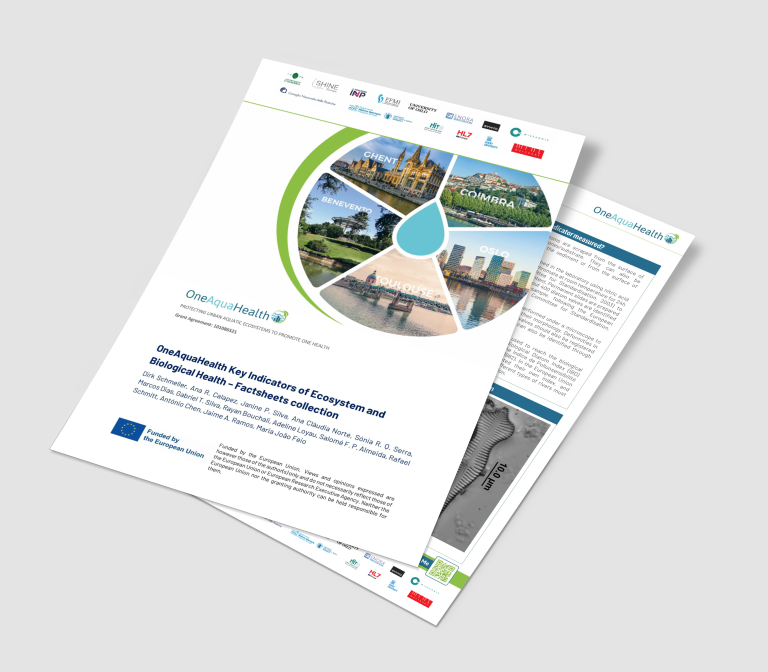
OneAquaHealth Key Indicators of Ecosystem and Biological Health
Factsheets collection
A set of harmonised ecosystem and biological health indicators, presented through dedicated factsheets explaining the relevance and interpretation of each indicator, including their link with the One Health approach.
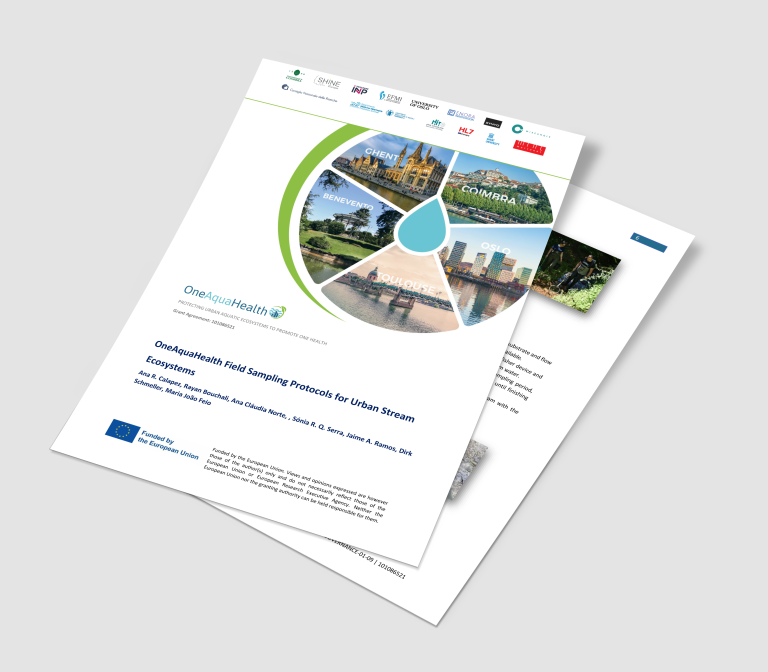
OneAquaHealth Field Sampling Protocols for Urban Stream Ecosystems
Sampling protocols developed within the OneAquaHealth project, guidance for data collection and harmonisation, and methods to support comparison across cities and monitoring sites.
WHY IT MATTERS
The framework helps reduce fragmentation in urban stream monitoring by providing a common and structured approach. As such it supports:
- more consistent ecosystem health assessment;
- comparison of results across cities;
- better integration of ecological and health-related information;
- stronger cooperation between environmental and public health actors;
- evidence-based monitoring, planning and prioritisation of interventions.
By linking ecosystem condition with potential public health implications, the framework supports the One Health vision promoted by OneAquaHealth.
DESIGN
INDICATORS FRAMEWORK - WHO CAN USE IT?
The Indicators Framework is designed for different groups working on urban streams, ecosystem monitoring, environmental planning and public health.
- Researchers and academic institutions can use the framework to design studies, collect comparable data, analyse ecological–health relationships and support teaching, fieldwork and student training.
- Environmental agencies and monitoring bodies can use it as practical guidance for assessing the ecological condition of rivers and urban streams through harmonised indicators and protocols. The framework also provides clearer methods to organise and interpret environmental data, supporting more consistent monitoring and reporting activities.
- Municipal and regional authorities can benefit from it to support urban river management, restoration planning and prioritisation of interventions based on evidence.
- Public health actors can use the framework as supporting environmental information when working with environmental authorities to better understand possible links between ecosystem conditions and population health.
HOW IT CONNECTS
TO ONEAQUAHEALTH DIGITAL TOOLS
The Framework helps define which data should be collected and how they should be collected in a consistent way. These data can then feed into other OneAquaHealth digital tools, including:
The Citizen Science App invites everyone to take an active role in understanding and protecting local stream ecosystems. By combining simple data collection tools with engaging features and clear visual feedback, the App empowers citizens to observe, report, and learn about the health of their urban waterways.
The OneAquaHealth City Dashboards are interactive web tools that make environmental and research data easy to access for citizens, researchers, and public institutions. By using intuitive visual interfaces, users can explore city‑specific indicators such as water quality, biodiversity, and pollution.
The OneAquaHealth (OAH) Resilience Map is an interactive tool that brings together biodiversity, environmental data, pathogens, weather, and satellite indicators to assess the health of urban water ecosystems across five European countries. Users can explore indicators, track changes, compare sites, and view data through dynamic maps, graphs, and tables. The tool supports evidence‑based decisions by offering clear insights and exportable data.
The Decision Support System (DSS) helps identify suitable rehabilitation measures for urban and peri‑urban streams. Users first select indicators describing the stream’s condition. The DSS then identifies likely impairments and their underlying stressors. Finally, it recommends matching rehabilitation measures. The tool supports expert judgement but does not replace it; local conditions must guide final decisions.
In this way, the framework provides the methodological basis for collecting comparable environmental and health-relevant data that can feed OneAquaHealth digital tools. Combined with these tools, the framework helps translate field observations into structured evidence for research, monitoring, planning and restoration. The indicators can also provide early signals of changes in urban aquatic ecosystems and help identify conditions that may be relevant for both ecosystem health and human health.
HOW THE FRAMEWORK WILL BE USED
The framework is intended to be used as:
- a reference methodology for ecosystem health assessment;
- a practical guidance tool for environmental monitoring activities;
- a teaching and training resource;
- a basis for comparative research across cities;
- a support tool for authorities interested in evidence-based planning and intervention prioritisation.