

OneAquaHealth DipteraCAST: Using Artificial Intelligence to Predict Disease Vectors in Urban Freshwater Ecosystems
How can artificial intelligence help us understand how urban environmental change affects insects that matter for biodiversity and public health?
This question inspired the development of OneAquaHealth DipteraCAST, an innovative Artificial Intelligence (AI) tool created by ENORA Innovation as part of the OneAquaHealth project. By combining environmental monitoring with advanced machine learning, DipteraCAST predicts the occurrence of Diptera communities – including mosquitoes and other ecologically and medically important flies – across urban freshwater ecosystems. DipteraCAST generates predictions from a concise set of environmental descriptors provided by the user that represent the characteristics of a study location. These include water quality, hydromorphological conditions, land use and climatic variables that together describe the local ecosystem.
As cities continue to grow and climate conditions change, understanding how insect communities respond to environmental pressures is becoming increasingly important. Many Diptera species are valuable ecological indicators, while others are known vectors of pathogens affecting humans and animals. Predicting where these species are likely to occur provides an important step towards proactive environmental surveillance and One Health risk assessment.
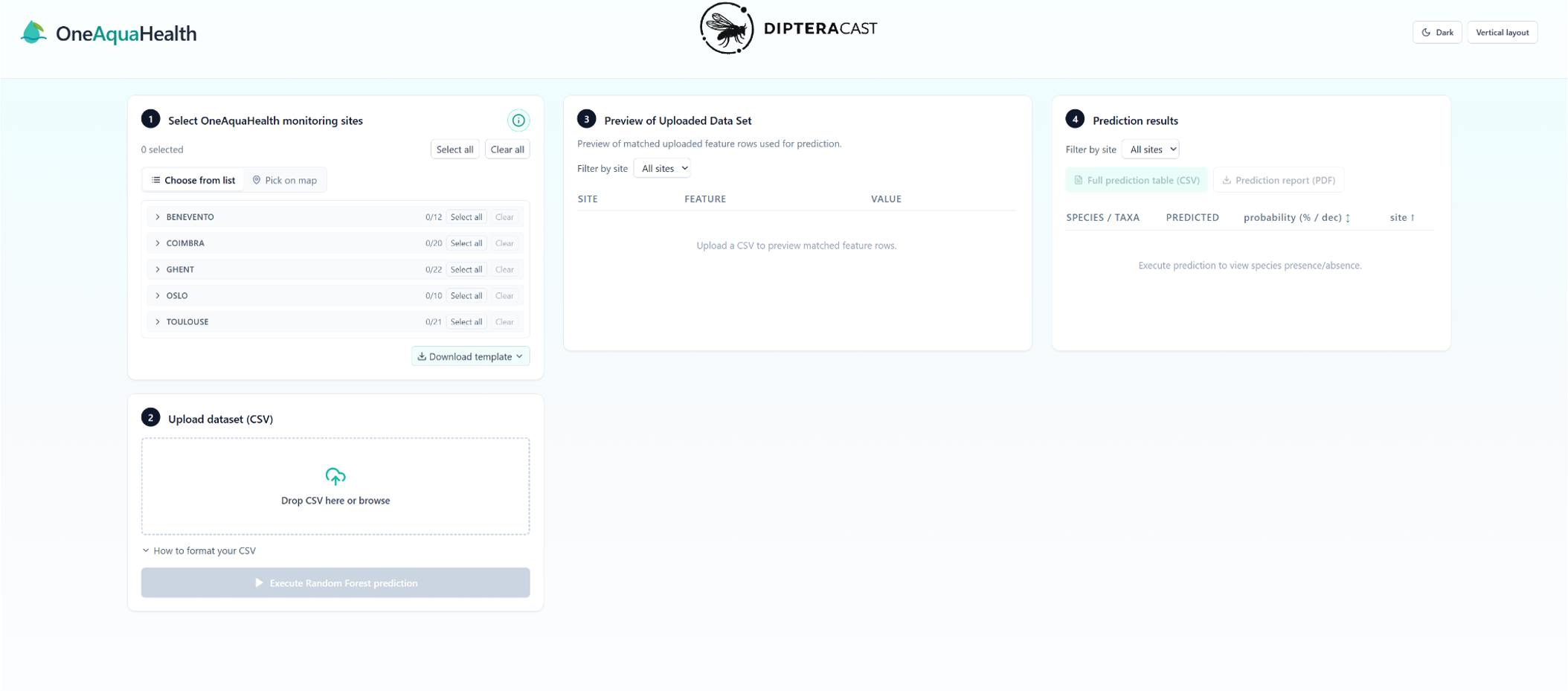
DipteraCAST is an AI-powered platform for ecological prediction that provides decision-support capabilities through predictive modelling and scenario exploration. It has been designed around a straightforward, user-friendly web interface that enables researchers and environmental practitioners to interactively explore alternative environmental scenarios by modifying key ecological, hydrological and climatic variables and immediately exploring their

Turning environmental data into ecological predictions
DipteraCAST was developed using environmental and biological data collected from 85 urban stream sites across five European cities as part of the OneAquaHealth project. The dataset includes water quality measurements, hydromorphological characteristics, land-use information, climate variables and remote-sensing products, together with observations of 55 Diptera taxa.
Using these data, DipteraCAST learns the relationships between environmental conditions and species occurrence. Once trained, the system can analyse new environmental datasets and estimate the likelihood of Diptera communities being present at a given location.
Rather than focusing on a single species, DipteraCAST predicts entire Diptera communities, providing a broader ecological perspective that better reflects how freshwater ecosystems function.
Artificial Intelligence designed for ecological complexity
Natural ecosystems are complex, and ecological datasets are rarely balanced. While some species are common, many others are observed only a few times, making prediction particularly challenging.
To address this, DipteraCAST evaluates several complementary machine-learning algorithms – including Random Forest, Logistic Regression, Support Vector Machines and Extreme Gradient Boosting (XGBoost) – within a robust multi-label prediction framework specifically designed for ecological applications.
Extensive testing demonstrated that these models successfully capture meaningful relationships between environmental conditions and Diptera occurrence. Random Forest achieved the highest overall predictive performance of community composition, while Logistic Regression performed particularly well for less common species, illustrating how different algorithms contribute complementary strengths.
The availability of multiple algorithms also enables comparison of model behaviour, improving transparency and supporting the selection of the most appropriate model for different ecological contexts.
Supporting environmental management and One Health
DipteraCAST has been designed as a practical decision-support tool rather than simply a research prototype.
By uploading environmental data collected from urban streams, users of the platform will be able to obtain predictions of Diptera occurrence under current conditions or alternative environmental scenarios. This capability can support:
- biodiversity monitoring;
- restoration planning;
- environmental impact assessment;
- ecological risk analysis;
- surveillance of medically relevant Diptera species;
- One Health decision-making.
This enables users to evaluate how changes in environmental conditions, restoration measures or climate-related pressures may influence future Diptera communities before they occur in the field.
The tool complements existing ecological monitoring programmes by helping identify potential changes in insect communities before they are observed in the field, supporting more targeted monitoring and management efforts.
Looking ahead
An important feature of DipteraCAST is its flexibility and extensibility. Rather than being restricted to the original OneAquaHealth study sites, the platform can be applied to any geographical location for which the required environmental descriptors are available. By allowing users to upload environmental data from new areas, DipteraCAST provides a reusable framework that can be progressively expanded with datasets from different regions, ecosystems and research contexts. This open and transferable design makes the platform suitable not only for environmental surveillance and One Health applications, but also for a broad range of ecological monitoring, biodiversity assessment and environmental management studies.
As new environmental data become available, DipteraCAST will continue to improve through enhanced prediction of rare species, geographically aware validation methods, and the integration of ecological relationships among species, thereby strengthening predictive performance.
The platform is also planned for integration into the OneAquaHealth Open Information Hub (OIH), where researchers, environmental agencies and decision-makers will be able to explore predictions through an intuitive web interface, evaluate alternative environmental scenarios, and better understand how changes in environmental conditions may influence Diptera communities.
By transforming environmental observations into actionable ecological predictions, DipteraCAST demonstrates how Artificial Intelligence can support proactive environmental surveillance, evidence-based environmental management, and One Health decision-making across urban freshwater ecosystems.
Author(s): Iphigenia Kapsomenaki, Enora Innovation