
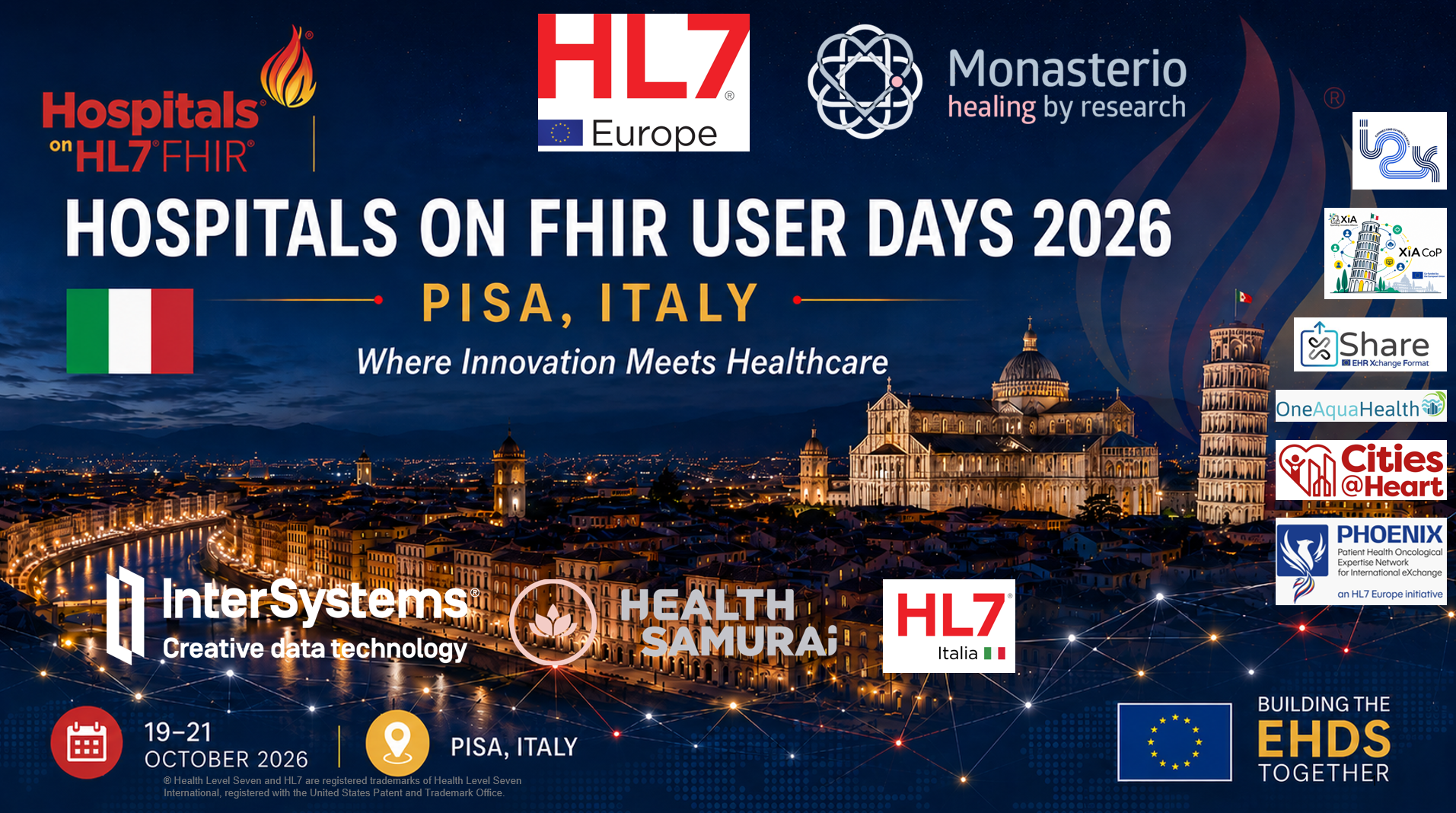
Hospitals on FHIR User Days 2026 explores the future of European digital health and the “One Health” vision in Pisa
PISA, ITALY – Europe’s leading healthcare innovators, policymakers, researchers, and technology partners recently gathered at the Monasterio Hospital in Pisa, Italy, for the Hospitals on FHIR (HoF) User Days 2026. Hosted by the Monasterio Foundation from October 19 to 21, the flagship event focused on the real-world implementation of HL7 FHIR and the future of interoperable digital healthcare across the continent. As Europe prepares for the implementation of the European Health Data Space (EHDS), EEHRxF, and the AI Act, the summit provided a crucial platform for hospital IT leaders, clinicians, and industry experts to address interoperability, cybersecurity, and clinical innovation.
A major highlight of the event occurred on October 20 during Session 9. Titled “HL7 FHIR for One Health: Connecting hospitals, environment and the city through shared terminologies,” the session explored how health information must transcend traditional hospital walls. Presenters emphasized that clinical care, public health, environmental monitoring, and city services must be able to exchange data while preserving its core meaning and respecting privacy boundaries.
To illustrate this interconnected ecosystem, Eva Sabajova from HL7 Europe (also consortium partner in the project OneAquaHealth) introduced the Cities@Heart perspective through the use case of Maria Rossi, a 72-year-old resident living near Pisa who manages cardiovascular disease and heart failure.
Sónia Serra from the University of Coimbra (coordinator of OneAquaHealth project) expanded the discussion by presenting the OneAquaHealth perspective, which links the health of urban aquatic ecosystems to human well-being. Serra explained how a degraded urban stream near a patient’s home can create a vicious cycle leading to poorer mental and physical health, while a healthy stream provides restorative spaces for physical activity and social connection. The OneAquaHealth project tracks four key stream metrics to assess these environments: macroinvertebrates and diatoms, diptera (disease vectors like mosquitoes), pharmaceuticals, and coliforms.
Connecting these diverse environmental and clinical data layers requires robust, standardized terminology. Stratos Kokolakis of HL7 Europe detailed the technical strategy for bridging these two worlds in his presentation. The solution relies on a shared geographic anchor within the FHIR framework known as LocationOah. By linking both environmental indicators (such as water temperature for a specific stream reach) and public health measures (such as cardiovascular disease prevalence for a specific demographic cohort) to the same location, systems can share vital context. This structural approach allows care teams to evaluate community-level environmental risks without ever placing a single patient’s identity into the public environmental data record.
The discussions at the HoF User Days 2026 demonstrated that true interoperability extends far beyond clinical settings. By leveraging HL7 FHIR to connect the patient, the city, and the environment, European health leaders are successfully laying the groundwork for more resilient cities and comprehensive, preventative healthcare.
Read the full presentation here.
Keywords: # HL7 FHIR # One Health # Interoperability # OneAquaHealth # Digital Health
Author(s): Stratos Kokolakis, HL7 Europe