

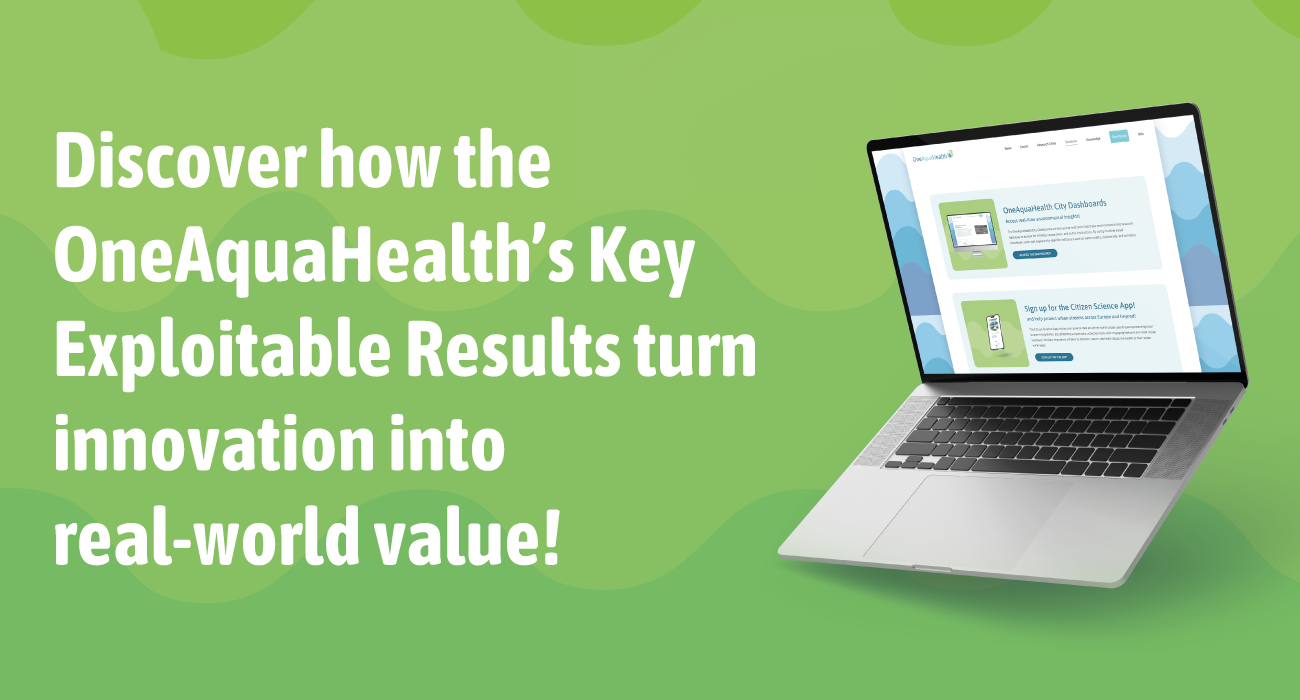
What makes a project result truly exploitable? Insights from OneAquaHealth
What makes a project result truly exploitable? Insights from OneAquaHealth
In many research and innovation projects, significant effort is dedicated to developing new tools, methodologies, and knowledge. However, turning these results into something that is actually used beyond the project remains a common challenge.
Within OneAquaHealth, this question is central: what makes a project result truly exploitable?
A Key Exploitable Result (KER) is not simply a project output. To be exploitable, a result must respond to a clear need, target a defined group of users, and offer a concrete value that justifies its adoption. Without these elements, even technically strong results risk remaining underutilized.
In this context, OneAquaHealth is focusing on a set of KERs that reflect the project’s interdisciplinary nature. These include the OneAquaHealth (OAH) tools – namely the Citizen Science App, GEOSSIP Platform (which includes earth observation, data management and visualization tools), the OAH Decision Support System, and the Indicators Framework (a set of innovative indicators to assess the health of urban aquatic ecosystems) – offering complementary solutions addressing different dimensions of the environment–health nexus.
Rather than functioning as isolated solutions, they are designed as an integrated framework that brings together environmental and health data within a One Digital Health approach that forms the backbone of the project’s value proposition. This supports a more comprehensive understanding of ecosystem–human health interactions, enabling more informed and holistic decision‑making.
A key challenge in making these results exploitable lies in clearly defining who they are for and how they will be used. Public authorities, environmental agencies, public health institutions, and local communities all represent potential users – but each with different needs, expectations, and capacities. A good practice in this context is the early and continuous engagement of stakeholders. OneAquaHealth has addressed this from the beginning by planning structured interactions with end users, including through dedicated workshops. These exchanges – facilitated by the Local Alliances and the collaboration between WP4 (stakeholder engagement) and WP6 (exploitation) – have proved essential not only for collecting feedback, but also for ensuring that the solutions developed are aligned with real needs and can be realistically adopted.
In addition, exploitation requires going beyond technical development and addressing practical conditions for uptake. This includes considering how tools can be integrated into existing workflows, what resources are required, and what barriers might limit adoption. Issues such as data availability, interoperability, institutional readiness, and long‑term maintenance all influence whether a result can move from prototype to real‑world application.
For this reason, OneAquaHealth places strong emphasis on aligning its results with user contexts, refining value propositions, and identifying realistic pathways for adoption. This means looking beyond technical performance and focusing on usability, relevance, and integration into existing processes.
Ultimately, exploitation is not a final step but a continuous process that runs in parallel with project development. By embedding this perspective early on, OneAquaHealth aims to ensure that its results are not only innovative, but also usable, relevant, and capable of generating real impact beyond the project’s lifetime.
Author(s): Alessandro Corsello, Wise Angle Consulting S.L.